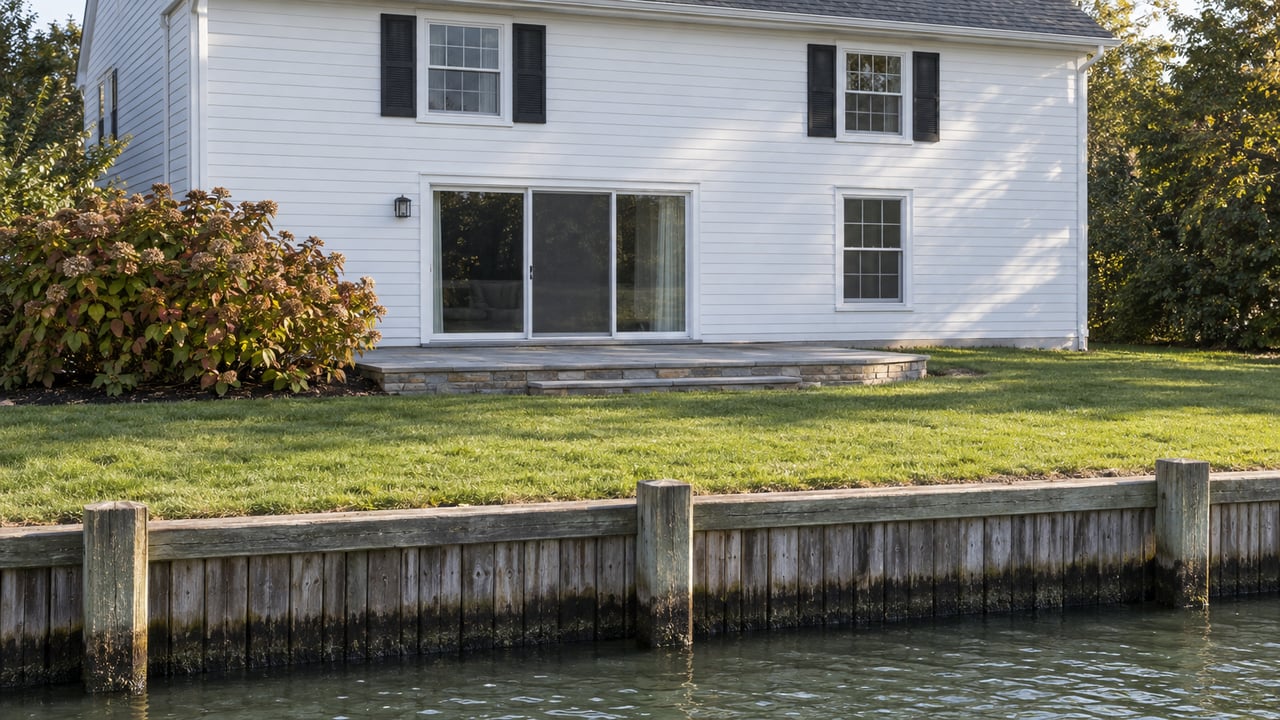
Why a Massapequa Bulkhead's Condition Decides Its Permit Path, Not Just Its Price
October 8, 2026
October 8, 2026
"Work on a structure that has so deteriorated that it is no longer functional, is not exempt from permit requirements." That sentence sits on the New York State Department of Environmental Conservation's tidal wetlands page. If you own a canal-front home in Massapequa, it may be the most important sentence in your bulkhead file.
Bulkhead questions usually come up as a price question: what will it cost to replace, and who pays. On Long Island the regulatory answer comes first, and it depends on the same thing the buyer's inspector is looking at. A bulkhead that still works can be replaced through a streamlined state process with no fee. One that has failed can lose that option.
DEC's General Permit GP-1-22-001 covers routine bulkhead replacement in Nassau and Suffolk counties. It took effect on October 25, 2022 and replaced GP-1-18-001. The current permit runs for 10 years, twice the 5-year term of the one before it. The signed permit lists its expiration as October 24, 2032, so it is in effect today.
The eligibility language is short. The permit covers "the removal and replacement of functional and lawfully existing bulkheads." There is no fee to request authorization under it.
DEC's FAQ says what happens to projects outside that language. Bulkheads the agency deems non-functional can be excluded. So can sites where DEC believes reasonable alternatives to a bulkhead exist, such as softer shoreline stabilization. Projects found ineligible "will be processed as standard tidal wetland applications," and DEC may ask for more information, including an alternatives analysis.
Neither the permit nor the FAQ gives a measurable test for "functional." DEC decides. A wall that is visibly sound when an owner applies is easier to place inside the general permit than one that is already leaning into the canal.
The general permit is not a bare like-for-like swap. It gives a working bulkhead real room to improve:
The last item matters on Massapequa's canal streets, where dredging next to the wall is often part of the reason to rebuild. The FAQ says dredging on open bay and river frontage is more restricted. It is limited to 5 feet offshore and subject to seasonal limits that protect fish and shellfish.
Some locations are excluded no matter what condition the wall is in. These include high wave energy areas, vegetated tidal wetlands, submerged aquatic vegetation beds, and marsh island communities. Projects there need an individual permit.
Because DEC judges whether a wall is functional, the warning signs a contractor or inspector looks for also bear on the permit route. Pearce Marine, a Long Island marine contractor, lists cracks, sinkholes, leaning or bulging, seepage, and soil washout behind the wall as signs of trouble. Its December 2025 cost guide says localized cap cracks or worn boards may be repairable. A leaning wall, significant soil loss, or rotted piles point toward replacement.
The same guide estimates that timber bulkheads last 15 to 20 years and vinyl lasts 50 years or more. DEC's eligibility test is whether the wall still functions, not how old it is. On a timber wall nearing the end of that service range, though, the question of whether it still qualifies is likely to come up during the sale itself.
Pearce Marine's December 2025 guide puts full replacement at $500 to $1,200 per linear foot. It breaks that down to $500 to $700 for pressure-treated wood and $700 to $1,000 for vinyl sheet pile. Its June 2025 repair guide estimates whole repair jobs at $2,000 to $15,000. That includes $2,000 to $5,000 for foam injection and $5,000 to $15,000 for structural reinforcement.
A March 2025 Pearce post aimed at Massapequa gives a separate repair range of $500 to $1,500 per linear foot. That unit price and the per-job figures measure different things, so they should not be added together or averaged. All of these numbers are a contractor's published 2025 estimates. A site visit is the only way to get a real price for a specific wall.
The gap between repair and replacement costs is large, but it is only half of what condition affects. A wall caught while repair is still an option, or while full replacement can still go through the general permit, avoids both the higher cost and the standard application process.
The second eligibility condition gets less attention, and it is one a seller can check from a desk. The general permit does not define "lawfully existing" or say what proof it requires. It does say that structures that are not lawfully existing "will not be validated or 'legalized'" under it. The Request for Authorization form linked from DEC's general permit page asks for the property's tax map section, block, and lot, plus any previous DEC permit or application numbers for the site.
Before listing, or during a buyer's due diligence, the record check goes in this order:
A permit number in hand when a buyer's attorney asks is much better than a FOIL request filed during attorney review.
Bulkheads appear by name on DEC's list of regulated structures, and the state's adjacent-area jurisdiction can extend up to 300 feet inland from a tidal wetland boundary. The same page says the U.S. Army Corps of Engineers may require its own permit whether or not DEC does. It also warns that starting work without all permits can lead to fines or an order to remove the work.
On the federal side, the Corps' Nationwide Permit 2 covers structures in artificial canals within principally residential developments, where the canal's connection to navigable waters was previously authorized. Nationwide Permit 3 covers maintenance of previously authorized structures that are currently serviceable. Its New York conditions favor in-place or landward replacement. The current conditions took effect March 15, 2026. The word "serviceable" in the federal maintenance permit raises the same condition question DEC asks.
Locally, Chapter 241 of the Town of Oyster Bay Code requires a waterways application to build or modify a bulkhead. The filing includes an environmental assessment, copies of state and federal submissions, a survey and plans, and a radius map. If the proposal crosses the property line, it goes to the Town Board, and affected waterfront neighbors must be notified at least 14 days before the hearing. Otherwise the Commissioner of Planning and Development decides after environmental review. The Town code does not publish a fixed turnaround time.
DEC sets no fixed review deadline for a general permit authorization. Its rule is that no work starts until the signed authorization arrives. For standard tidal wetlands applications, DEC generally has 15 days to decide whether an application is complete. After that, its published decision deadlines are 45 days for minor projects and 90 days for major ones without a hearing.
Shoreline projects with public funding and a contractor already hired can still slip. The Town of Oyster Bay's bulkhead replacement at John J. Burns Town Park in Massapequa was first scheduled to finish October 30, 2024. According to the Massapequa Herald, it was completed January 29, 2025. The Town Board approved final payment on March 10, at a final cost of about $5.2 million against a $5.63 million contract. A private wall going through state, federal, and Town review needs that same kind of buffer in a sale timeline.
Does replacing a few broken boards need a DEC permit? DEC's own example says replacing broken boards on a functional dock does not require one, but changing its length, width, or position does. The exemption does not cover a structure that is no longer functional. For a specific wall, confirm with DEC Region 1 and your attorney.
Can a new bulkhead go farther out into the canal? Under the general permit, re-sheathing can extend no more than 4 inches seaward with timber or 8 inches with corrugated material. Full replacement must be in place or landward.
Is the general permit still in effect? The signed GP-1-22-001 lists an expiration date of October 24, 2032. DEC keeps the authority to modify, suspend, or revoke it, so confirm with Region 1 before relying on it for a project.
If you're thinking about selling a canal-front home in Massapequa, The Kim Holland Homes Team can help you collect the bulkhead's permit history, line up a contractor's condition assessment, and set the order of work before the listing goes live. Get in touch, and bring whatever paperwork you have on your wall.
Stay up to date on the latest real estate trends.

We offer unmatched local knowledge, expert negotiation, waterfront expertise, and proven marketing strategies to get homes sold faster and for top dollar.
Get In Touch With Our Team To Learn More

1000 Park Blvd Suite F
Massapequa Park NY 11762